Why it matters

Where CCTV actually goes wrong.

The failures are rarely dramatic. An image that will not identify anybody. A recorder that left with the intruder. Footage overwritten before anyone asked for it. The cameras were on the whole time.

We design around that moment. Cameras positioned to identify people and vehicles, recording that survives the recorder being taken, and a written retention policy, so you know exactly what you hold and for how long.

How a site is covered

Cameras at the edges. Evidence off site.

The compliance bit

CCTV records personal data. That has consequences.

Worth knowing before you buy: if your organisation operates CCTV that captures people beyond your own household, you are processing personal data under UK GDPR. In most cases that means paying the ICO data protection fee, displaying signage that says who is recording and why, setting a retention period and sticking to it, having a lawful basis, and being able to respond when somebody asks for footage of themselves. Some deployments also need a Data Protection Impact Assessment. We are installers, not your legal advisers, but we design to these requirements and will tell you when a camera position creates a problem rather than letting you find out later.

How it goes

Survey, design, install, maintain.

The survey decides whether the system produces evidence. Everything after it is execution and upkeep.

The Survey
  • What each camera must be able to identify
  • Lighting, glare and night conditions
  • Power and connectivity available on site
  • Positions checked against privacy obligations
The Install
  • Cameras and lenses chosen for the distance
  • On-site NVR, cloud recording, or both
  • Solar, battery and cellular where needed
  • Signage and retention set at handover
Afterwards
  • System health monitored continuously
  • Retention and storage checked
  • Footage exports handled when you need them
  • Cameras cleaned and re-aimed as needed
Book a CCTV survey
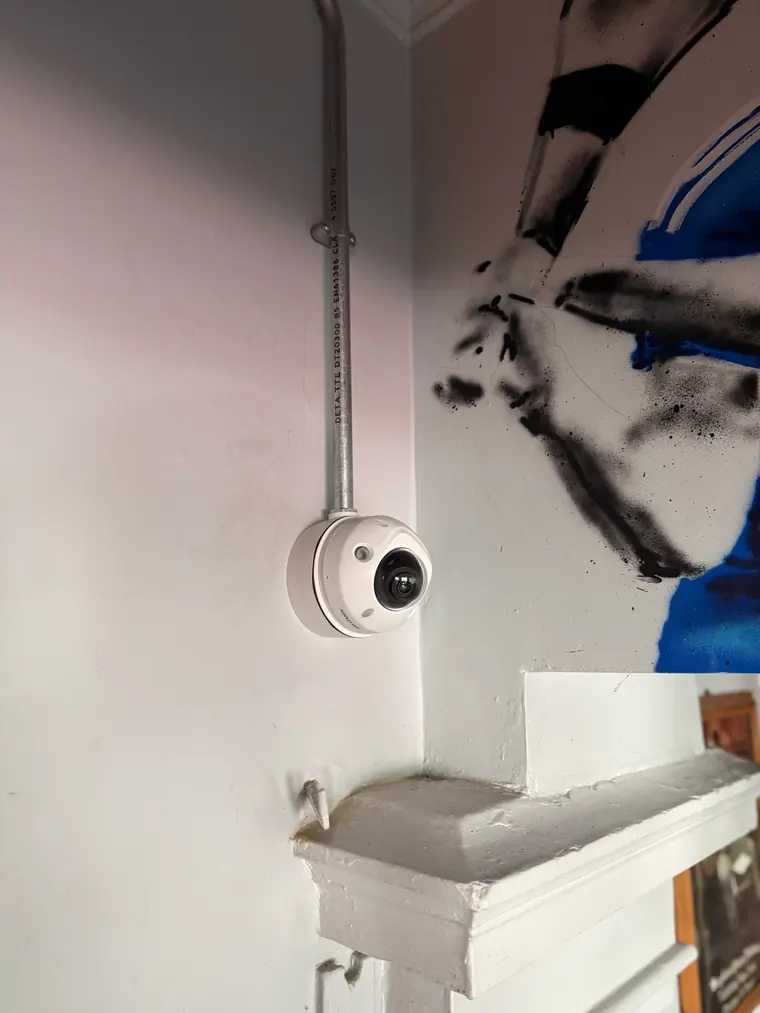
A compact white dome camera mounted inside on galvanised steel conduit, against a wall with a painted mural
Indoors
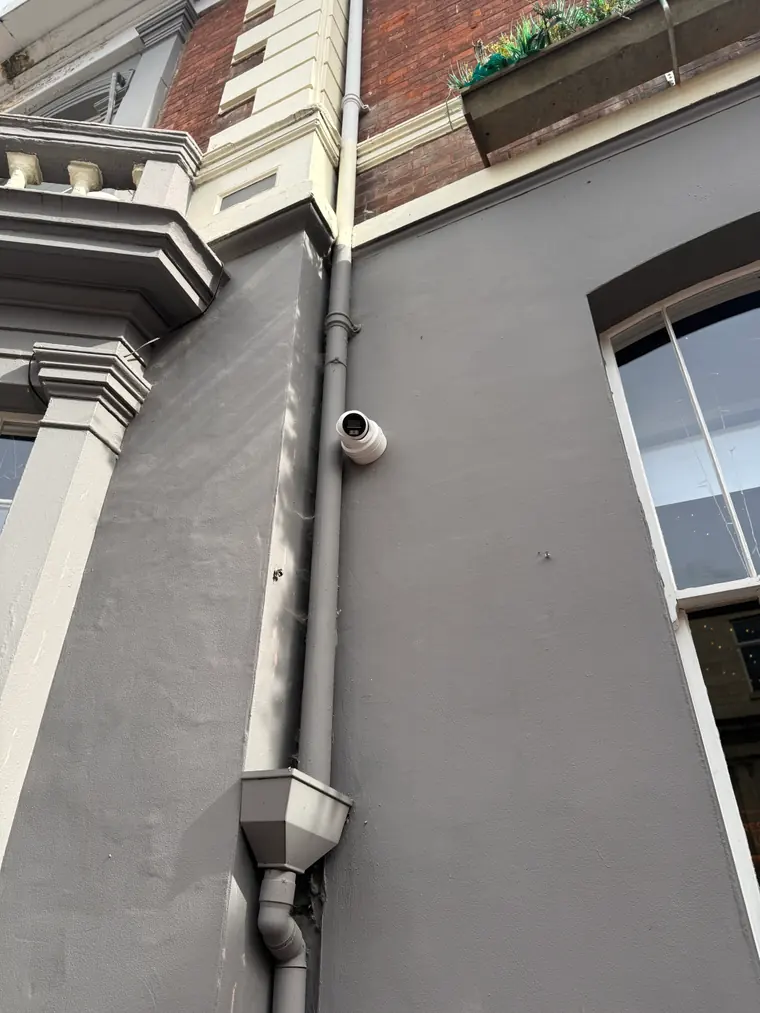
A white turret camera mounted high on the rendered facade of a period building, positioned beside the rainwater pipe to cover the frontage
Outdoors
What we install

From a shop floor to a field with no power.

The Straightforward Sites

Offices, warehouses, retail and schools. Cameras positioned for identification rather than for looking impressive on a plan, and a system somebody actually maintains.

  • Positioned for usable images
  • Lighting and glare considered
  • Maintained, not fitted and forgotten
Planned camera by camera

Cloud Recording with Videoloft

Footage leaves the building as it is recorded, so a stolen or smashed recorder does not take the evidence with it. It also adds cloud to cameras you already own.

  • Works with existing cameras
  • One view across multiple sites
  • No recorder to steal
Off site as it records

On-Site NVR Where It Fits

Local recording is still the right answer on plenty of sites: cheaper, long retention, and no upload bandwidth needed. We will tell you which one your site wants.

  • Long local retention
  • No upload bandwidth required
  • Hybrid with cloud for critical cameras
Both options, honestly compared

No Power, No Broadband

Solar, battery and cellular for compounds, fields, car parks and gates. Sized for the worst month of the year, because a camera that dies in January is not a camera.

  • Solar and battery sized for winter
  • 4G and 5G connectivity
  • Remote power monitoring
Off-grid and still recording

ANPR and Long Distances

Number plates at the entrance, and coverage across sites where the camera is a long way from the thing it is watching. Both are lens and lighting problems before they are camera problems.

  • ANPR at entrances and barriers
  • Long-range and thermal options
  • Wireless backbone across the site
ANPR entrances and barriers

Compliance Designed In

CCTV records personal data, which brings real obligations. We design to them and flag where a camera position creates a problem, rather than leaving you to find out later.

  • Signage and lawful basis
  • Retention set and documented
  • Access requests possible in practice
UK GDPR considered from the survey
FAQ

Common questions about CCTV.

Should footage record to site or to the cloud?

Both are valid and the honest answer depends on the site. A traditional on-site recorder is cost effective, keeps a lot of footage and does not need much upload bandwidth. Cloud recording, which for us usually means Videoloft, sends footage off site as it is captured, so a recorder that is stolen or smashed does not take the evidence with it. That matters most on exactly the remote and unstaffed sites this page is about. Videoloft also adds cloud to cameras you already own, so it is often the answer for a client who does not want to rip out a working system.

Can you put cameras somewhere with no power or broadband?

Yes, and it is a good part of what we do. Power comes from solar and battery, sized for the worst month of the year rather than the average one. Connectivity comes from 4G or 5G, or from a wireless link back to a building that has a circuit. The design work is in the sizing and the mounting, because a camera that browns out every January is worse than no camera.

Do we need to register with the ICO for CCTV?

If you are an organisation operating CCTV that captures people outside your own household, you are processing personal data, which in most cases means you need to pay the ICO data protection fee and comply with UK GDPR. That brings obligations: signage telling people they are being recorded and who by, a defined retention period, a lawful basis, and a route for people to request footage of themselves. Some deployments also need a Data Protection Impact Assessment. We are installers rather than your legal advisers, but we design to these requirements and will tell you where a camera position creates a problem.

How long should we keep footage?

Only as long as you actually need it, which is the legal position rather than a technical one. For most businesses that is somewhere between two weeks and a month, driven by how quickly incidents come to light. Keeping everything forever is not the safe option; it increases your exposure without improving your evidence. We set the retention to the period you decide and document it, so the answer exists before somebody asks.

Can you cover a long site or several buildings?

Yes. That usually means a wireless backbone between buildings rather than trenching cable across a site, cameras chosen for the distances involved, and sometimes ANPR at the entrance. We survey the site and design the network alongside the cameras, because on a large site the network is the part that decides whether the system works.

Will you work with cameras we already have?

Where they are worth keeping, yes. We will tell you honestly if they are not: very old analogue cameras or ones that cannot produce a usable identification image are a false economy. Where the cameras are sound but the recording is weak, adding cloud recording to the existing system is often the cheapest meaningful upgrade available.

Survey first, quote after

Tell us what you need to see.

Start with what the cameras have to achieve rather than how many you think you need. If your existing system is fine and only the recording is weak, we will say so.